
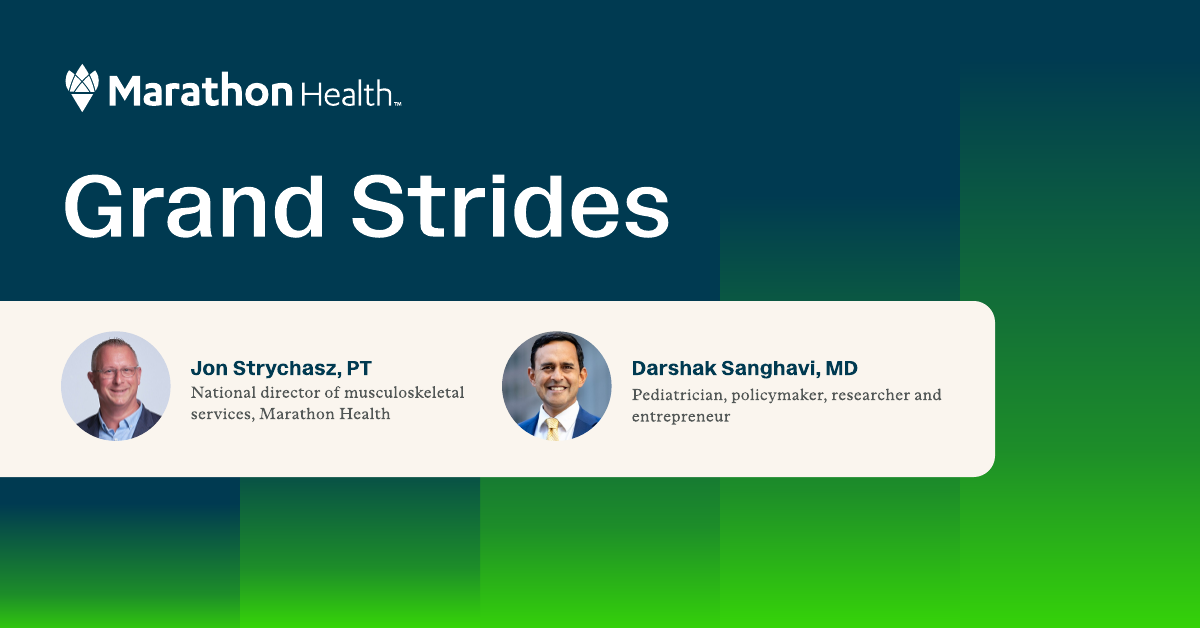
In this Grand Strides session, Jonathan Strychasz, PT, Cert MDT, Cert DN, NBC-HWC, national director of musculoskeletal services at Marathon Health, held a fireside chat with Darshak Sanghavi, MD. With a career spanning clinical practice, policy leadership, and healthcare innovation, Dr. Sanghavi offered a unique perspective on building healthcare systems that foster higher trust and more impactful patient-provider relationships. Explore the conversation between Jon and Dr. Sanghavi below as part of our ongoing series, where we connect with clinical leaders charting new paths in primary care and prevention.
Aligning incentives to outcomes
Q: You’ve worn a lot of hats—pediatrician, policymaker, researcher, entrepreneur. If there’s one big problem or curiosity that’s motivated your work across these sectors, what would that be?
Dr. Sanghavi: I’m a healthcare optimist. I believe clinicians are always trying to do the right things for their patients. I’m obsessed with creating the right environment—whether it’s the right tooling, the right office setting, the right payment models—so that doing the right thing for patients becomes the thing that’s good for your institution. Aligning the two builds intrinsic motivation, fights burnout, and allows for growth.
.png?width=850&height=170&name=1%20(4).png)
The challenges and concerns arise when those things don't align—whether in practice or coverage decisions. Much of my work focuses on solving the inefficiencies where clinicians are fighting upstream to do the right thing.
Q: Take us back to your time with the Obama administration. At CMMI you architected key programs focused on proactive health like the Million Hearts Cardiovascular Risk Reduction model and the Medicare Diabetes Prevention Program. What are some of the key learnings to help us shift from a “sick care” system to a “well care” system?
Dr. Sanghavi: Let’s start with the cardiovascular risk model—the big question was: how do we create a payment model for something that didn’t happen, like preventing a heart attack or stroke? We took a very simple approach—instead of focusing on individual metrics like blood pressure or cholesterol, the program used a modified version of the American College of Cardiology/American Heart Association’s risk calculator to determine the 10-year cardiovascular risk across each provider’s full panel. Providers were incentivized for managing this overall risk. What happens when you empower and trust your clinicians to manage their populations? For the first time in American history, we securitized a future outcome in healthcare. After five years, there were measurable reductions in mortality and cardiovascular events. Across all programs we learned that when clinicians are incentivized for future outcomes and given the right tools, they deliver better care for their patients.
Innovation equation: Balancing humans and tech
Q: Within Marathon's health centers, we’ve found success in coordinating care across disciplines—primary care, behavioral health, musculoskeletal, and more. But there are still times when patients need to engage with the broader healthcare system—community resources, specialists, hospitals, etc. What innovations are you seeing to help support care navigation so care feels truly continuous for patients?
Dr. Sanghavi: Think of care navigation like air traffic control—tracking patients through their entire journey to help them stay on course. Let’s take a complex care journey like cancer, for example. Today, clear quality metrics are primarily focused on screenings (mammograms, colonoscopies, etc.) and that’s where the measurement ends: screenings completed, provider gets quality payment, everyone’s happy. Health plans are spending billions of dollars managing these metrics, yet data we analyzed showed that about one-third of those with abnormal screenings never show up for follow-up. In other words, we estimate that about 100,000 Americans are walking around with curable cancer.
.png?width=850&height=170&name=2%20(2).png)
We know who they are, and they haven't gotten care yet. Why? Because we don’t have care navigation—or that air traffic control—in place. What excites me is the emergence of new organizations and new technology accelerating the move to go beyond single quality measures to tracking entire care journeys, ensuring nobody gets left behind.
Q: There’s understandable concern that technology might one day replace the human side of medicine. How can technology enhance primary care delivery, helping providers deepen relationships with patients?
Dr. Sanghavi: No patient says, “I want more AI and technology.” They say, “I want my questions answered faster,” or “I want to get my medication as quickly as possible,” or “I want to make my appointment for tomorrow.” It’s key to focus on the outcome you’re trying to achieve—not just having the ingredient of technology—and whether technology is helping or hindering your progress.
When considering technology’s impact on clinical interactions, think about how we build relationships as people. The dream is that technology can handle basic information gathering and operational work quickly, creating space for providers to spend time on the questions that AI doesn't think of or can’t answer. In an era where human connection is less and less common, the hope is that technology allows us time to create more. My optimism is that we don't use technology to increase clinicians’ volume by 25%, but rather allow clinicians to use that 25% to do the things that bring joy to themselves and their patients.
Rebuilding trust in healthcare
Q: Given the decline of public trust in healthcare and the growing disconnect patients feel, what operational changes can primary care implement to rebuild trust and what system-level supports are needed to make this sustainable?
Dr. Sanghavi: Generally, as humans, we only think about our individual experience. When it comes to building patient trust, access and availability are the most important North Star. If you need care, how quickly does a provider show up for you? If you send a portal message, how timely is the reply? These are the types of things that are self-reinforcing. Trust is also built among peers. It’s crucial to consider community building and reputation building in the equation. Whether it’s face-to-face or online social networks, word-of-mouth continues to be the ultimate way to organically build trust. Encourage your patients to share their experiences.
Unfortunately, for a long time, many people haven’t felt well served by healthcare—and we have the opportunity to pioneer change. It’s so rare for people to feel like the system is responsive. If you're able to show that you're actually there, trust follows fairly quickly.
.png?width=850&height=170&name=3%20(4).png)
What this means for you
Whether you’re a plan sponsor or a clinician, the future of healthcare hinges on building trust, aligning incentives, and leveraging technology to support—not replace—the human connection. With solutions like advanced primary care, consider how you can:
- Empower employees by making care accessible, responsive, and personalized.
- Champion innovation to support the entire care journey, ensuring no one gets left behind.
- Build trust through transparency, timely communication, and a commitment to listening.
By working collaboratively, we can create a healthcare experience that delivers better outcomes, greater satisfaction, and lasting impact for all.
About Grand Strides
Marathon Health’s Grand Strides series brings our clinical community together for candid conversations with trailblazers in healthcare. These sessions are designed to spark new thinking, share actionable insights, and inspire our teams as we navigate the evolving landscape of care.
Looking for more healthcare optimism? Read the recap from Grand Strides with Dr. Amy Abernethy.
.png?width=850&height=170&name=4%20(4).png)
About Grand Strides
Marathon Health’s Grand Strides series brings our clinical community together for candid conversations with trailblazers in healthcare. These sessions are designed to spark new thinking, share actionable insights, and inspire our teams as we navigate the evolving landscape of care. Looking for more healthcare optimism? Read the recap from Grand Strides with Dr. Amy Abernethy.