
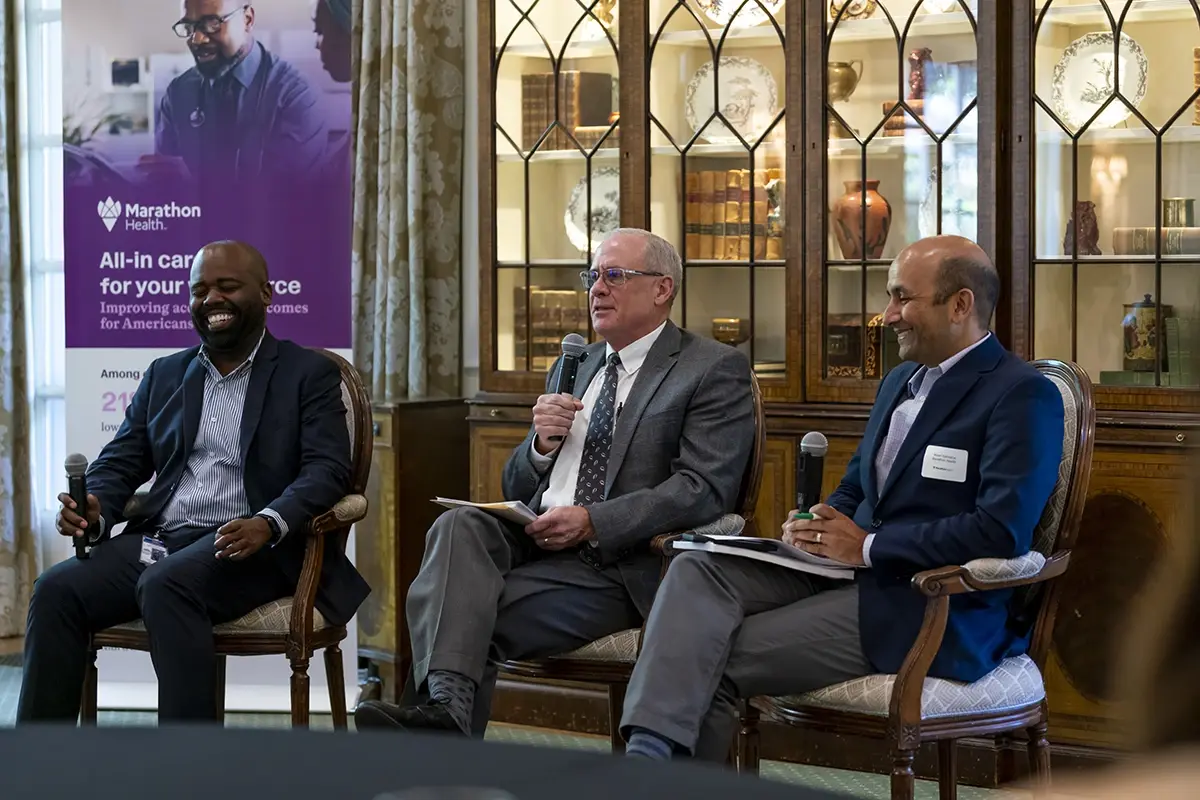
Across the country, business and government leaders are rethinking what it takes to make health care more accessible and effective. Marathon Health recently convened a series of roundtable discussions to explore how employers, health care providers, and policymakers can partner to expand access to primary care.
Much of the conversation focused on one of today’s greatest challenges: meeting the growing demand for mental health support. Participants also discussed the ways technology can help bridge care gaps and how integrating mental and physical health within primary care creates a stronger foundation for whole-person well-being.
From Columbus, Ohio, to Richmond, Virginia, and Charlotte, North Carolina, learn how innovative leaders are making a difference in their communities and workplaces.
Improving access and affordability of healthcare in Charlotte
For the Charlotte Roundtable, Nirav Vakharia, MD, Chief Operating Officer at Marathon Health, led a discussion on health care access and affordability, notably how to disrupt barriers to care and deploy effective solutions to improve outcomes for millions in the region.
The panel featured public-private sector leaders, including Chris Paterson, PhD, CEO of Carolina Complete Health Plan, Raynard Washington, PhD, Mecklenburg Public Health Director, and keynote guest, Dimple Ajmera, Charlotte City At-Large Council Member.
The discussion highlighted efforts ranging from tackling medical homelessness to building local partnerships that improve care delivery—all reinforcing one central idea: better health outcomes happen when public health leaders, employers, and health care innovators work together.
Dr. Vakharia kicked off the discussion with some sobering facts about the current state of the U.S. health care system:
- 100 million people are medically homeless without access to primary care
- Only 8% meet their age-specific prevention guidelines
- Over 60% of Americans experience financial hardship from medical debt
- The U.S. spends the most on health care, averaging $14,000 per person annually
“When we compare ourselves to other countries, our outcomes aren't where they want to be, but we spend a whole lot more, which means this is more about, ‘How do we better allocate the resources we do have?’” Vakharia says.
Care must address social determinants of health
The panel agreed, the biggest opportunity lies in prioritizing population health and investing in prevention on the front end. The challenge goes far beyond health care itself, and leaders must recognize the well-documented social determinants of health that routinely prevent people from seeking care.
“It's where people live, how they live, what they eat, and how they recreate, as well as their ability to actually connect to the health care system,” Washington says. “One of our commissioners often says, ‘access is a verb,’ and a person's ability to actually be able to go to a place, receive the care they need that honors who they are as a person, is all a part of the equation."
“But if the people who need them most can't use them, you have to ask yourself: What are we achieving in terms of community health as a whole?” he adds.
Doubling down on primary care
Washington explained when you look at federal or state health care budgets, most of the funding goes to Medicaid and health care institutions that treat people who are already sick.
“We know a lot about how to keep people from getting sick, but we don't invest a fraction of that in keeping people from getting sick,” he says. “At that point, the costs are excessive. So, we end up with the outcomes and the systems we have today, which are largely fragmented."
Paterson suggested health plans should invest more in holistic, primary care to reduce spending later on the acute side, where care gets extremely expensive.
“We need to make sure we're putting a lot more money into primary care, so there's less money spent in acute episodes,” Paterson says. “And you’d be surprised that primary care is not a huge budget line for health—not by far.”
Comprehensive primary care goes beyond treating physical symptoms. It also means integrating behavioral health within primary care. When providers take time to support patients’ mental and emotional well-being together, they often see better outcomes in areas like chronic disease management, medication adherence, and overall quality of life."
“If you're going to approach people holistically, the first question you should be asking is, ‘What are their behavioral health or substance abuse needs?’” Paterson says. “That can solve a lot of problems on the front end. That will translate into savings on the acute care side, just as we were talking about down the road.”
Bringing care to rural communities
North Carolina has the second-largest rural population in the country, second to Texas. With about 3.7 million people living in rural areas, the state has embraced innovation to expand health care access to all corners of the Tar Heel state.
That effort has led to greater use of virtual care solutions and technology, such as text-based communication, to connect patients with care. It also prompted the Department of Health and Human Services to hire community health workers and establish advanced medical homes across the state, many funded in part by Medicaid health plans.
“We actually have providers that put care managers inside their practices,” Paterson says. “This is particularly important in rural areas. They can solve issues beyond vaccines and other health care complications that our physicians have to pay attention to. They can look at some of the softer side of people's needs that then enables them to have health care."
“I've been impressed at how we’ve taken the challenge of rural health care seriously in this state, and we've pushed resources in that direction as much as we could,” he adds.
Expanding access in Mecklenburg County
In Mecklenburg County, Washington says the health department’s job is to stay closely connected to the community’s health. The county conducts a community health assessments to gather data, identify needs, and shape its public health strategy. He notes that access to care consistently ranks as one of the top concerns.
“Over the last few years, we’ve really lasered our attention to this issue of access to care, specifically thinking about primary care and care that happens in the community setting, rather than care that happens in acute facilities,” Washington says.
Washington shared an example from Mecklenburg County’s public schools, where the health department partnered with a major health care system and a philanthropic organization to expand access to care. Together, they installed school-based virtual care in nearly half of all Charlotte-Mecklenburg Schools, and in every Title I school across the district.
The program allows students to get care without leaving school. If a child gets sick or experiences a behavioral health crisis, they can visit the school health room, and connect virtually with a physician, nurse practitioner, or behavioral health provider.
“It does a couple of things,” Washington says. “In addition to increasing access to care, it keeps that kid in school, it stops parents from having to leave work, and it ultimately connects that kid to a system of care that allows them to be able to receive care on an ongoing basis.”
In another example, Washington says he worked with the Board of County Commissioners to direct additional health care funding toward primary care to ensure all residents—including those who can’t access insurance through the exchange or Medicaid expansion—can still see a primary care doctor and get a physical.
“At a minimum, I think that's what our residents deserve,” Washington says. “We've been able to invest in a network of primary care providers to make that access possible for more than 20,000 residents on an annual basis.”
The secret sauce in employer-based preventive care
Beyond serving rural and underserved populations, Washington explains how Mecklenburg County ensures all employees and their families can access high-quality primary care and preventive services. He said the “secret sauce” to getting employees engaged in preventive services is simple: offer incentives.
“Our employees receive significant reductions on their contributions if they complete certain tasks,” Washington says. “You have to get an annual physical, and you also have to complete some modules and health coaching if your metabolic levels are off. There's some accountability on the employee to actually be healthier.”
Biometric screenings for blood pressure, cholesterol, and metabolic health do more than uncover hidden risks. They help employees understand their health and feel empowered to take control.
“If you make it simple for employees, you’ll inevitably see an impact because they know their numbers,” Washington says. “They participate because of the incentive, and you as an employer end up with lower costs and better outcomes, especially if you're self-insured.”
Bringing holistic primary care to the City of Charlotte
Ajmera spoke about the City of Charlotte's approach to improving access to primary care and preventive services. In 2017, the city partnered with Marathon Health to offer free and low-cost advanced primary care through a network of dedicated health centers strategically located across Charlotte.
Employees and their families can book same-day appointments for primary care, acute needs, behavioral health, and physical therapy. With little to no copay, the program makes high-quality care both convenient and affordable for the city’s workforce.
“This is a model that other cities and municipalities across the nation look up to,” Ajmera says. “They say, ‘Wow, you've got this model where employees can get an appointment the same day and really have affordable health care for 8,000 city employees.’”
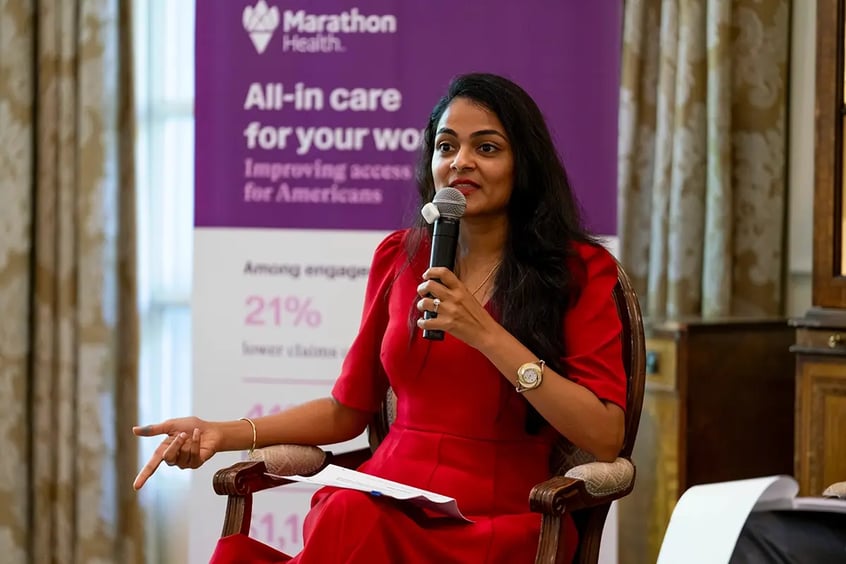
Ajmera says the city’s economic vitality is directly tied to their workers’ health and wellbeing. “If you have healthy employees, you have a thriving workforce.”
She explained how the city can offer these services through a strong partnership between the City of Charlotte, the local Business Alliance, and health care providers like Marathon Health.
“When businesses are able to lead by example, by investing in their employees when it comes to affordable health care, and forming innovative partnerships like the City of Charlotte has with Marathon Health, I can tell you, we as the region thrive.”
Access the full panel discussion and fireside chat here.
.png?width=728&height=90&name=Image%20Blade%20-%20Charlotte%20Cornerstone%20Event%20On-Demand%20%20(728%20x%2090%20px).png)
About Grand Strides
Marathon Health’s Grand Strides series brings our clinical community together for candid conversations with trailblazers in healthcare. These sessions are designed to spark new thinking, share actionable insights, and inspire our teams as we navigate the evolving landscape of care. Looking for more healthcare optimism? Read the recap from Grand Strides with Dr. Amy Abernethy.