
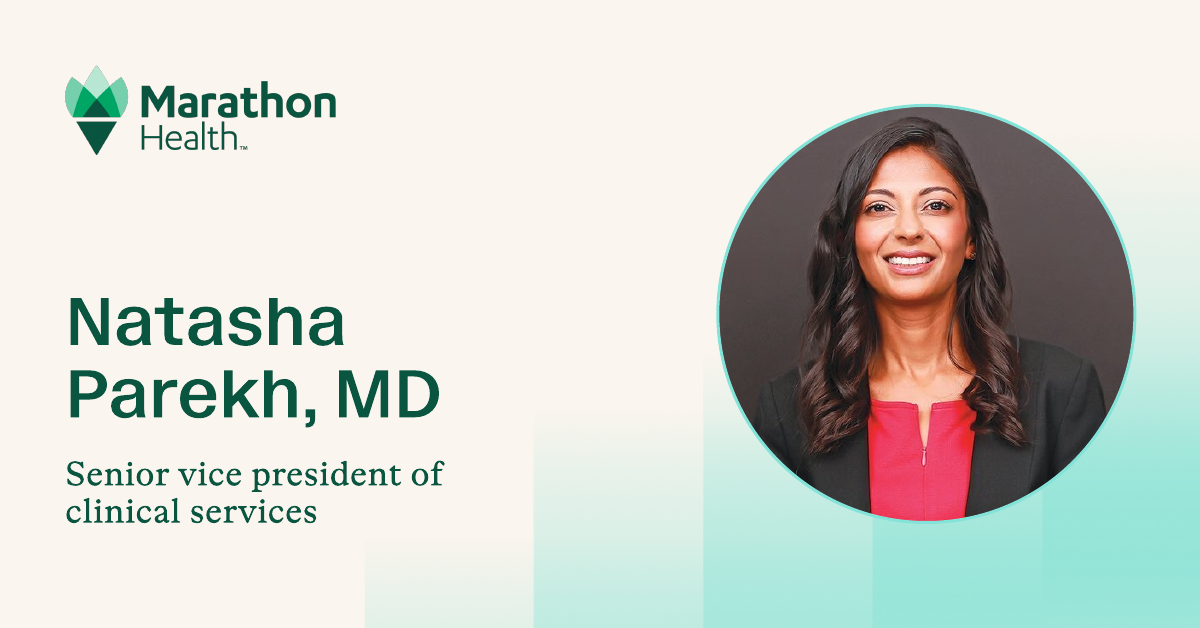
As senior vice president of clinical services at Marathon Health, Dr. Natasha Parekh brings a systems-level lens to primary care, grounded in the belief that when our patients receive comprehensive, whole-person support, outcomes improve for everyone.
That perspective has shaped a career spanning clinical care, population health research, value-based care, and health system leadership. It has also earned her recognition beyond medicine, including being named a 40 Under 40 honoree by the Tampa Bay Business Journal.
In the following conversation, Dr. Parekh reflects on the experiences that shaped her path, how she approaches leadership at scale, and why elevating women’s health as core care is central to building a more equitable and effective healthcare system.
Tell us about your path into medicine
I went to medical school at the University of Miami Miller School of Medicine and began my clinical training at Jackson Memorial Hospital. Early on, I saw how challenging it can be for patients to navigate the healthcare system, especially in communities facing deep disparities.
Many of the patients I cared for struggled with language barriers, health literacy gaps, financial stress, and limited access to insurance and care. Seeing what it truly meant to be uninsured or underinsured stayed with me and shaped how I thought about medicine.
Those experiences made it clear that while I wanted to care for patients one-on-one, I also wanted to address the systemic barriers. I didn’t yet know what that path would look like, but I knew I wanted to help build solutions, not just treat symptoms.
That interest led me to focus on underserved populations during medical school and eventually to residency training at the University of Pittsburgh Medical Center. My residency coincided with the rollout of the Affordable Care Act, sparking important conversations about how healthcare reform would affect patients, providers, and health systems.
As a resident, those discussions pushed my thinking beyond individual encounters and toward population health and value-based care. I became increasingly interested in how we design systems that improve outcomes at scale.
How did population health work influence your career path?
After completing residency, I pursued a fellowship focused on population health and value-based care. I earned a Master’s Degree in Health Services Research and had the opportunity to work closely with Pennsylvania’s Medicaid program through a University of Pittsburgh partnership. I conducted research on disparities in outcomes, with a particular focus on women’s health and geographic and race-based inequities across the state.
What I found most meaningful wasn’t just publishing research, but seeing my work influence real decisions. Sitting down with Medicaid leadership to talk through policy implications and program design showed me how data and evidence could directly shape operations and reduce disparities. That translation, from research to action, became a defining theme in my career.
Those experiences laid the foundation for everything that followed including subsequent roles as a Senior Advisor at the UPMC Health Plan and Chief Medical Officer of Queen’s Clinically Integrated Provider Network, grounding my work philosophy in the belief that healthcare works best when we align clinical care, policy, and incentives around value, not volume, and around people, not transactions.
Tell us about your current role at Marathon Health
Today, I serve as senior vice president of clinical services at Marathon Health. At its core, my role is about supporting our clinical teammates so they can succeed in our care model and deliver a consistent, high standard of care, no matter where they practice.
Marathon Health commits to providing high-quality care across the country, in both urban and rural communities, and to incredibly diverse patient populations. That scope brings both opportunity and responsibility. My job is to help ensure a patient’s experience and outcomes don’t depend on geography, employer size, or local resources.
What did the 40 under 40 recognition mean to you?
I was honored to be named to the 40 Under 40 list by the Tampa Bay Business Journal. The award recognizes leaders in the local community who are under 40.
What makes the recognition especially meaningful to me is that it’s a business award, yet I’m a clinician. I don’t traditionally think of my work through the lens of business accolades, but that’s exactly why this honor resonates so deeply. It acknowledges the reality that healthcare leadership today lives at the intersection of clinical care, strategy, and business impact.
Being included alongside business leaders who are transforming industries across the Tampa Bay community feels incredibly affirming. My role may start with medicine, but so much of my work focuses on supporting our organization, patients, teammates, clients, and the systems that make high-quality care possible.
More than anything, the award reminds me that clinicians have a powerful voice beyond the exam room.
How are you advancing women’s health as core service at Marathon Health?
I help lead our women’s health initiatives with a simple but powerful belief: women’s health is health. Historically, there has been real variability across healthcare in what falls under the scope of women’s health and who is expected to deliver it. Part of my role is helping bring clarity and consistency to that picture.
I spend a lot of time thinking about what belongs in our core care model and what every primary care provider across Marathon Health should feel confident supporting. That work led to the creation of a multidisciplinary group called Women Empowered in Lifelong Living (WELL). This group brings together clinical teammates from across our organization, including primary care providers, physical therapists, mental health specialists, health coaches, and dietitians. We all work together to shape and advance our women’s health strategy.
Right now, that strategy focuses heavily on education, because education is foundational. We developed a comprehensive women’s health education program designed for both patients and clients. While primary care anchors the content, we intentionally take a whole-person approach. We emphasize mental health, nutrition, sleep, movement, and overall well-being, because women’s health spans far beyond reproductive care alone.
At the same time, we’ve invested just as deeply in provider education. The reality is that women’s health looks very different depending on training background and past experience. We wanted to reduce that variability by establishing clear, evidence-based training within the context of primary care. As a group, we developed core women’s health knowledge and content structured around four distinct life phases: Adolescence, Early Adulthood, Fertility & Family-Building Years, and Beyond Reproductive Years.
Beyond foundational education, we’re also focused on building pathways for more advanced women’s health services. Not every provider across our organization performs procedures like IUD insertions or Nexplanon placements, and that’s okay. But for providers who are already trained or who want to expand their skills, we’ve created detailed toolkits to support them. These toolkits cover clinical competencies and practical guidance, including how to navigate client conversations and set appropriate expectations.
This work matters because it empowers our care teams while expanding access for patients. By pairing strong education with thoughtful clinical infrastructure, we can meet women where they are, support providers at every level of practice, and continue to evolve our care model in a way that’s both inclusive and sustainable.
About Grand Strides
Marathon Health’s Grand Strides series brings our clinical community together for candid conversations with trailblazers in healthcare. These sessions are designed to spark new thinking, share actionable insights, and inspire our teams as we navigate the evolving landscape of care. Looking for more healthcare optimism? Read the recap from Grand Strides with Dr. Amy Abernethy.